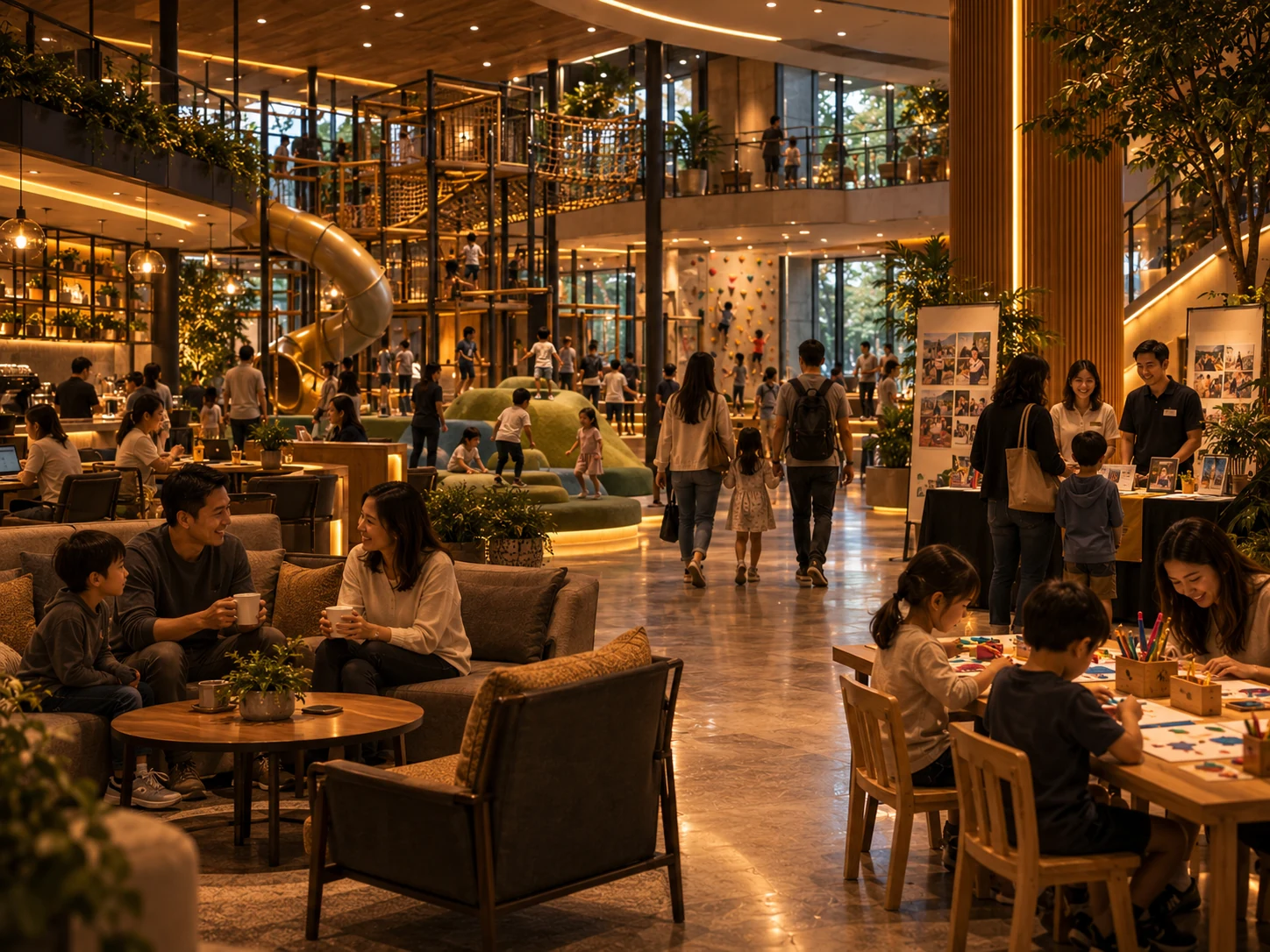
Family entertainment centers and family events are often treated as leisure amenities, but research suggests they can play a broader role in community development. Communities that want to attract new family residents and increase satisfaction among current residents need visible, accessible, and repeatable family experiences.
Family-centered places and events can support child development, physical activity, parent-child interaction, social connection, resident attachment, local pride, and positive word-of-mouth. Qualitative parent interviews show that families value entertainment centers not only for attractions, but for the whole experience: affordability, different-age engagement, adult comfort, safety, cleanliness, food, convenience, shared time, renewal, and developmental opportunities. For cities, this points toward a broader model: family entertainment centers and family expos can become social, developmental, and economic infrastructure.
Communities Compete for Families
Cities compete not only for employers, tourists, and investment. They also compete for families who decide where to live, raise children, spend time, participate, and build long-term attachment.
The Urban Institute emphasizes that family formation and retention shape future workforce supply, school-system viability, and regional equity. Families support school systems, pay property taxes, invest in local businesses, and anchor future labor supply. This makes family attraction a strategic issue for communities, not only a residential real-estate issue.
Family-friendly communities are usually discussed through housing, schools, child care, safety, transportation, and parks. The American Planning Association describes family-friendly communities as places where families have access to affordable housing, child care, parks, quality schools, safe neighborhoods, and recreation amenities. These foundations remain essential. However, many communities still lack a visible, everyday platform where families can gather, children can develop, parents can connect, and local organizations can reach family audiences.
A family entertainment center can help fill this gap when it is designed not only as a play facility, but as a repeat-use community asset.
Satisfaction Is Not Enough: Communities Need Recommendation Behavior
Attracting new residents is only one side of the problem. Communities also need current residents to feel satisfied, attached, proud, and willing to recommend the place to others.
Research on residents’ place-related behavior shows that place satisfaction and place attachment are different. Chen and Dwyer found that place satisfaction strongly predicts residents’ intention to stay or leave, while place attachment more strongly influences word-of-mouth, ambassador behavior, and participation in destination planning.
This distinction is important for city leaders. A satisfied resident may remain in the community. An attached resident may do more: recommend the city, invite friends and relatives, support local initiatives, participate in public life, and become an informal ambassador.
The Gallup/Knight Foundation Soul of the Community study also found that social offerings, openness, aesthetics, and education were among the strongest drivers of residents’ attachment to their communities. Family entertainment centers and family events directly contribute to this category of social offerings. They give families more reasons to meet, participate, celebrate, and feel that the community is designed for their lives.
Family Entertainment Is Also Child Development
Family entertainment should not be reduced to “keeping children busy.” Play, physical activity, creativity, and social interaction are connected to healthy development.
The American Academy of Pediatrics states that play supports parent engagement, safe and nurturing relationships, executive functioning, language development, imagination, collaboration, problem solving, and creativity. The CDC identifies physical activity benefits for children including improved academic performance, brain health, muscular fitness, heart and lung health, bone strength, healthy weight, and long-term health.
For communities, this means a family entertainment center can support several public goals at once. It can provide movement, exploration, creativity, skill development, social connection, and family time. The strongest model is not entertainment instead of development, but development through engaging experiences.
Parents Want Complete Family Systems
Our qualitative interviews with parents show that families do not evaluate family entertainment centers by one attraction in isolation. They evaluate the total visit: cost, age fit, parent comfort, cleanliness, safety, food, amenities, and whether the venue provides a fresh reason to return.
This matters for communities because a single attraction may create a short-term visit, but a complete family system creates repeat use.
Parents described affordability as a frequency issue. The concern is not only the ticket price, but the total cost of multiple children, food, parking, add-ons, and repeated visits. Families want pricing structures that make frequent use feel rational, predictable, and controllable.
Parents also need spaces that work for different ages. The interviews support separate but connected experiences: safer areas for younger children and progressively more difficult physical, athletic, interactive, and skill-based activities for older children.
The adult experience is also central. Parents described the need for comfortable seating, clear viewing positions, quieter areas, lounges, working tables, Wi-Fi, drinks, and spaces where adults can talk or work while remaining connected to children.
A successful community family center therefore should not be designed only for children. It should work for the whole family: children, teenagers, parents, grandparents, caregivers, and local partners.
Repeat Visits Require Renewal and Progress
Communities do not benefit as much from one-time attractions as they do from repeat-use family places. Repeat visitation creates habit, attachment, relationships, and local spending.
Parents in our research explained that children become bored when a center offers the same experience every time. Suggested solutions included seasonal programs, themed nights, workshops, rotating attractions, levels, certificates, missions, competitions, and visible progress.
This finding is especially important for cities. A family entertainment center can become more than a place to play once. It can become a place where children return because they are improving, creating, completing projects, preparing for competitions, joining clubs, meeting friends, or reaching the next level.
That is the difference between a static attraction and a family development platform.
Family Events Are Community Infrastructure
Family events, including family expos, children’s business fairs, educational festivals, parent-child challenges, seasonal celebrations, and community discovery days, are also important for communities.
Research on the social value of community events suggests that events can affect social cohesion, community capacity, and social capital. This means that events should not be evaluated only by attendance or immediate spending. They can also build relationships, visibility, civic participation, pride, and trust.
A family expo can be especially valuable because it brings many community actors into one place: families, schools, nonprofits, libraries, parks and recreation, local businesses, activity providers, health and wellness organizations, youth programs, sponsors, and city departments.
For current residents, a family expo can increase awareness of local resources, create shared experiences, and strengthen the feeling that the community is active and supportive. For prospective residents, it becomes a visible signal: this is a place where family life is taken seriously.
Family events can also function as community research. They allow cities to observe participation, collect parent feedback, test program ideas, identify unmet needs, and discover potential partners before making permanent investments.
The Broader Community Opportunity
The strongest opportunity is to connect permanent family entertainment centers with recurring family events.
The center provides continuity. Events provide renewal.
The center gives families a reliable place to return. Events bring new energy, partners, themes, and reasons to invite others.
The center supports everyday use. Expos and festivals make the family ecosystem visible.
Together, they can help communities attract new family residents, increase satisfaction among current residents, and strengthen recommendation behavior. They also support local businesses, schools, nonprofits, youth programs, tourism, and public agencies by giving them a shared platform for family engagement.
Our parent research points toward a shift from equipment-centered entertainment to family-centered experience design. Families still want exciting attractions, but loyalty becomes more likely when the visit works economically, accommodates different ages, gives parents meaningful options, supports shared time, feels clean and safe, reduces friction, and continues to change or develop over time.
Conclusion
Family entertainment centers and family events should be understood as part of a community’s family infrastructure.
They help children play, move, create, learn, and develop. They help parents connect, participate, recover, and spend meaningful time with their children. They help local organizations reach families. They help cities demonstrate that families are not only residents, but central participants in community life.
For communities that want to attract new family residents, these centers and events make family life visible. For communities that want to retain and satisfy current residents, they create reasons to participate, return, feel proud, and recommend the place to others.
The next generation of family entertainment centers should therefore be more than collections of attractions. They should become flexible family platforms: places where fun, development, social connection, community identity, and local vitality work together.
References
- American Academy of Pediatrics. (2018). The power of play: A pediatric role in enhancing development in young children. Pediatrics, 142(3), e20182058.
- American Planning Association. (n.d.). Family-friendly communities and planning resources.
- Centers for Disease Control and Prevention. (n.d.). Physical activity benefits for children and adolescents.
- Chen, N., & Dwyer, L. (2018). Resident satisfaction, place attachment, and word-of-mouth or ambassador behavior in community and destination contexts.
- Gallup & Knight Foundation. (2010). Soul of the Community.
- Godovykh, M. (2026). What Parents Want from Family Entertainment Centers: Beyond More Attractions. Family Entertainment Research.
- Godovykh, M. (2026). The Family Entertainment Park of the Future: From Attraction Venue to Adaptive Family Experience Platform. Future Experience Research.
- Godovykh, M. (2026). Novelty Decay: Why Children Get Bored With the Same Family Entertainment Park. Future Experience Research.
- Urban Institute. (2024). Research and commentary on family formation, family well-being, and regional resilience.